

For the past 40 years, Mexico has been the poster child for the Washington Consensus in Latin America. After the debt crises of the 1980s, the country pivoted away from state-led protectionism and remade itself in the image of the American economic model.
Its privatized state-owned enterprises and deregulated industries were supposed to bring in foreign direct investment. The signing of the North American Free Trade Agreement (NAFTA), and later the United States-Mexico-Canada Agreement (USMCA), on paper, worked. Mexico went from an oil-dependent nation to a global industrial powerhouse. Now, you have high-tech manufacturing creating cars, aerospace components, and medical devices.
Yet, despite doing everything the economists and consultants said, the Mexican economy still has not grown at pace for three decades. The current numbers are now exposing the structural issues of the country’s institutions.
Reality of Stagnation
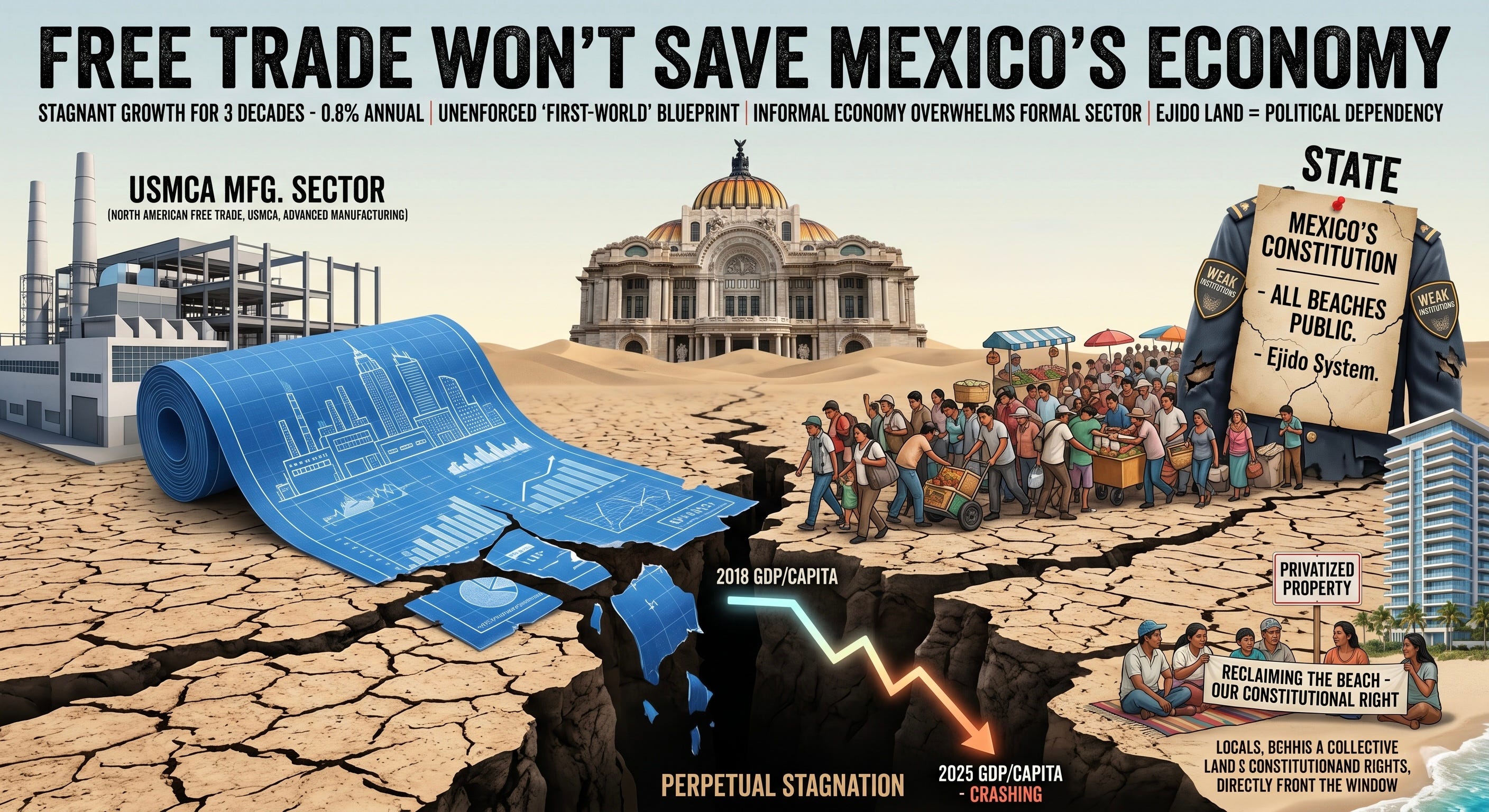
The data for the mid-2020s shows that trade agreements alone cannot pull Mexico into first-world prosperity. Mexico’s GDP growth plummeted to 0.8%. In the first quarter, the Mexican economy went down another 0.6%, killing the slight gains of the previous year and making it the worst first-quarter performance since the pandemic.
The worst metric of this multi-decade stagnation is shown in the people.
Mexico’s real GDP per capita is now lower than it was back in 2018, despite raising the minimum wage. The average citizen is actually moving backward.
The question is: How can a country with a world-class manufacturing sector, a direct land border with the largest consumer market on earth, and a massive influx of nearshoring capital still fail to grow?
Copying American models without American Instititions
Mexico’s economic failure comes from a fundamental mismatch in how the state works. The state built an Anglo-style market on top of weak institutions where it either cannot or will not enforce rules. Free markets (despite the name) thrive because they are backed by strong enforcement, judiciaries, and individual private property rights. When Mexico copied the American model, it imported the deregulation and the trade ideas, but it failed to build the state capacity required to anchor them. Essentially, the economy operates in a legal vacuum.
With no strong state to guarantee the rule of law, the benefits of globalization are reserved for the productive elite,multinational corporations and large domestic industries that have the legal teams and international protections to isolate themselves from local institutional issues. For the rest of the country, small businesses and everyday workers just get taxed on survival. Contract disputes take years to resolve in corrupt local courts, regulatory enforcement is arbitrary, and cartels operate against the very ideas of commerce. Because the state doesn’t provide basic security, the everyday person benefits nothing.
It’s easy to say that maybe the people are simply lazy and lack the drive or capability to scale businesses. However, under Mexican law, the state has created a dual economy by taxing and regulating formal employment and private property, while shielding and providing social safety nets to the informal sector, both in protest by the average citizen, but also in the name of protecting culture.
If you choose to go formal, you are hit with compliance costs, rigid labor laws, and high tax rates. If you operate informally, the state ignores you or allows you to pay to keep your freedom.
The government historically expands social programs (free healthcare, cash transfers, and pensions) to target informal workers in order to maintain political control, even though it’s an irrational decision in terms of progress. Logically, it keeps people happy while keeping them in the lower classes. They remain tiny, low-yield operations, street stalls and small workshops, while the rich get richer. Half of the labor pool is trapped in a subsidized cycle, which ultimately drags down national growth.
The Systems of Control
Take for example: ejido land. The state made a deliberate decision to choose collective control over individual wealth after the Mexican Revolution. The Mexican state expropriated tracts of agricultural and rural land from the wealthy and handed it to indigenous communities and farmers. The catch was that the government did not give these peasants deeds to the land. Instead, the land was granted to the community. They are legally banned from selling, leasing to enterprises, or using the land as collateral without legal loopholes.
This never actually creates any long-term economic growth or a self-sustaining middle class. The Institutional Revolutionary Party (PRI) simply created a system where the people depend on the state. But people stay loyal to the state because they are given crumbs. This is the opposite of how Western nations drive economies.
When wealthy developers or foreign buyers purchase beachfront properties in places like Quintana Roo or Baja California, they arrive with an American expectation of private property. While the average citizens protest this, they fail to understand that the system is in place so they themselves cannot generate wealth either. They are loyal to the system that gives them crumbs at the expense of national progress. This allows the wealthy elite to continue to cash in while letting others be the scapegoats.
To fix this, the people must realize that the crumbs are not enough:
You must get rid of the idea that informality is culture.
Build proper fiscal and labor frameworks so that the formal economy is cheap, streamlined, and beneficial.
Move away from antiquated collective property ideas and gain legal structures that allow capital for local investments.
Enforce the Rule of Law to guarantee security, destroy systemic corruption, and suppress organized crime.
Until this is done, the people will stay in a perpetual state of stagnation.
If you’re an outsider, you may argue that fixing these institutional issues may kill the very reason you are attracted to the land. But coincidentally, if you have a disdain for outsiders, this is exactly what you would do to stop their encroachment.