
Coatlicue: Mexico’s Supercomputer May Be Mexico's Great Leap Forward Event
Who Survives Tomorrow?

* This article is an opinion based on my “educated” thoughts after years of working in military and global logistics before moving into the Tech/Cloud/AI world. I could be wrong, I could be right. But these are my controversial thoughts.
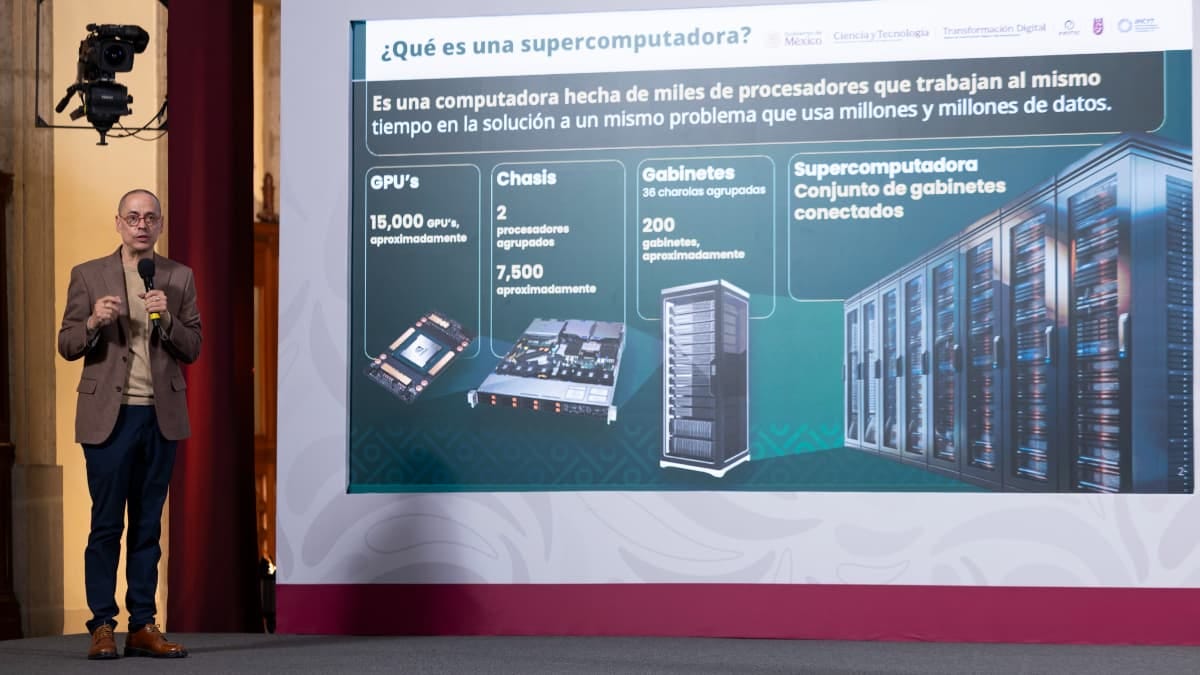
Mexico is unveiling Coatlicue, a national AI supercomputer with the compute power of roughly 375,000 machines running in parallel.
On paper, it is the most ambitious technological upgrade the country has attempted in decades, a move normally associated with nations like Singapore or the UAE…places where infrastructure and political stability justify these investments. Instead, Mexico is rolling it out during one of the most unstable periods it has experienced in years.
Farmers are unable to make a living from their crops.
Truckers are hijacked or extorted on highways that were supposedly federal and secure.
Doctors feel abandoned by the system, their wages stagnant while public hospitals fall apart.
Teachers march for basic resources.
Cartels expand geographically while the state shrinks territorially.
The peso only stays strong, artificially, at the expense of exporters and local producers.
Nearshoring hypotetically could deepen inequality faster than it creates sustainable development.
Most assume this is either a tone deaf technocratic fantasy or another example of the government funneling funds into opaque projects that help friends, donors, or political allies.
Some interpret it as an attempt to signal “modernity” to foreign investors without addressing the structural rot that prevents real modernization.
But there is my dark interpretation that the political class will never say publicly, but becomes possible when you look at global patterns.
Governments don’t always invest in the population they have.
They invest in the population they want to exist in 20 to 30 years.
China did this during the Great Leap Forward. Tens of millions died while the state restructured the economy according to its long term strategic vision. The regime didn’t creat policy for its poor and peasants; it designed them to becomie and industrialized superpower.
El Salvador did its own version under Bukele, removing a significant portion of the country’s violent population in less than two years so the remainder could accelerate economically. Singapore, South Korea, and the Gulf States built their modern societies not by uplifting every region or demographic but by prioritizing the regions and populations most aligned with their future economies. Everyone else gets left behind.
Mexico could be entering its own version of this logic.
Coatlicue is for the Mexico that the state hopes will exist after the current one has been reshaped, fragmented, or partially discarded.
Coatlicue could provide the computational backbone for a very different kind of Mexico, built around automation, surveillance, industrial optimization, energy analytics, climate forecasting, robotics, and a digitally oriented workforce.
So the uncomfortable truth follows.
Coatlicue Is About Sovereignty
The official explanation from government agencies frames Coatlicue as a national scientific tool. They describe it as a resource for academic research, environmental modeling, medical breakthroughs, and innovation in biotechnology. Some of that is true. But I don’t think it’s the real driver.
Coatlicue actually represents a sovereignty project.
In the twenty first century, sovereign compute is the new oil.
It is what will determine which nations have control over their economic destinies and which nations become dependent clients of larger powers.
Countries no longer simply compete over physical territory or natural resources. They compete over access to chips, data, compute, and algorithmic influence. The countries that control these things will dictate the economic hierarchies of the next century. The countries that depend on foreign cloud providers, foreign GPU supply chains, or foreign data centers will have their futures shaped by someone else.
Europe already understands this and is panicking about falling behind. China has been placed under strict U.S. export controls to try to slow down its AI development. Saudi Arabia and the UAE are stockpiling GPUs the way everyone stockpiled gold.
Mexico does not want to rely entirely on Amazon, Google, or Microsoft to run critical infrastructure or host sensitive national data. And even if it wanted to, U.S. export controls and political mood swings make that dependence dangerous. If the U.S. decides that certain sectors of the Mexican economy cannot access certain levels of compute, Mexico becomes a subordinate, not a partner, and America has already shown some hostility in the recent decade.
Coatlicue could be Mexico’s attempt to prevent that scenario.
Mexico is hedging against a world where access to advanced AI models becomes restricted, where resources go first to U.S. allies, and where developing nations are left technologically stranded.
The Timing
You do not build a national supercomputer during nationwide discontent, and declining public trust unless you have already decided that the instability is either temporary, containable, or irrelevant to your long term vision.
Mexico’s political class often has not oriented national investment around the needs of the population. But in the past, the tech didn’t exist to accelerate it.
When I look Mexico’s demographic trajectory, it makes sense. Fertility rates have collapsed. Rural populations are aging. Farming is becoming economically unviable. Low skill labor is becoming less competitive. The internal migration patterns overwhelmingly point toward urban concentration and the regions that receive foreign investment look nothing like the regions that actually represent the majority of the Mexico.
This sounds cynical, but its how many states manage transitions.
Who Coatlicue Is Built For
The benefits will likely overwhelmingly be concentrate in regions that are already positioned as hubs of economic growth, technological infrastructure, industrial development, and foreign capital absorption.
Cities like Mexico City, Monterrey, Querétaro, Aguascalientes, Guadalajara, Mérida, Cancún, and the rest of the Bajío industrial corridor are the intended beneficiaries. These zones already attract high tech manufacturing, logistics, telecommunications investment, research capacity, and multinational corporations.
By contrast, regions like rural Oaxaca, Guerrero, Michoacán, Chiapas, Zacatecas, Hidalgo, Durango, and Tamaulipas…areas marked by aging populations, weak infrastructure, or cartel influence are not being positioned for integration into the future Mexico.
Whether explicitly or implicitly, that the future economy will be urban, industrial, analytically driven, and globally integrated. The regions that cannot fit into that model will simply be managed, subsidized, or bypassed.
The Strategic Uses
Predictive Policing and Intelligence
Human intelligence is too slow. Manual analysis can’t keep pace with cartel networks operating across dozens of states. Coatlicue give the state the ability to model criminal patterns at scale.
The government can run simulations to identify extortion corridors before they form, predict kidnapping hotspots based on historical movement patterns, analyze telecommunications metadata to uncover cartel communication structures, and optimize drone deployment.. Who knows. Those are just my ideas. While politicians are often in bed with cartels, I think they all realize that it’s simply not a sustainable business model
Water, Climate, and Collapse Dynamics
Mexico is a severe water crisis. Every other year it becomes a stories. Northern states are drying out and Mexico City is has multi-decade aquifer issues. Southern states get hurricanes and flooding.
Some cities will receive resources and others will be quietly left to manage decline.
Technology will be needed to fix this.
Energy Optimization
Pemex and CFE are both not doing good, but they keep a monopoly to the national economy. Mexico needs to simulate oil reservoir depletion, optimize refinery operations, predict pipeline theft risks and calculate energy loads necessary for trade corridors.
Industrial Policy and Nearshoring
Foreign investors are now demanding predictive modeling of infrastructure, logistics ect before they commit capital. IF Mexico can simulate entire industrial forecast it might be able to drag the population into the future.
If mexico can strengethn it’s negotiating position, maybe it can become long-term player instead of risk exploitation by say, Chinas, who is already begun making a foothold in Mexico.
Automation and Labor Replacement
One of the harshest use is that Mexico is preparing for a future that requires fewer workers, both due to technology and law birth rates.
A large portion of low skill labor will be automated out of existence just like in the rest of the world. Robotics will have to replace workers in manufacturing. AI will have to replace customer service staff. Agricultural automation will need to reduce agricultural labor.
The Regions Mexico Will Abandon
Mexico may effectively dividing itself into “future zones” and “managed decline zones.”
The regions that get infrastructure, industrial investment, energy guarantees, and security protections form could form a corridor stretching from Mexico City through Querétaro, Guanajuato, Aguascalientes, San Luis Potosí, Monterrey, Saltillo, and extending toward key areas of Yucatán and Quintana Roo.
The regions not receiving such investment like rural Chiapas, rural Oaxaca, large parts of Guerrero, the Sierra regions of Michoacán, rural Zacatecas, interior Tamaulipas, Hidalgo’s rural zones, and parts of Veracruz will get left off. These people will die off, become peasants or need to move to city centers.
Maybe they’ll keep getting subsidies, but they will not be a priority
Question - Can Mexico Survive This Modernization?
Since my believe is that Mexico is attempting something ambitious..these transitions historically require institutional discipline, elite stability, territorial integrity, robust public trust, and strong governance.
Mexico currently lacks all of these in sufficient quantities.
Technology does not guarantee national success and could even set Mexico back decades if failed…
Expats, Investors, and Anyone Planning to Stay Long-Term
My guess would be that, If you live in Mexico City, Monterrey, Querétaro, or the broader belt, you are located in the zone Mexico expects to carry into the future.
If you live in Mérida or the Yucatán corridor, your region will increasingly integrate purely into tourism.
For investors, It could be a green light.